Top 5 Magnesium Forms for Different Health Goals (And the One to Avoid)
Not all magnesium is created equal. Here are the five best forms for specific health goals, ranked by absorption — and the one form worth avoiding.

D.C.
Doctor of Chiropractic
Founder of FormulaForge. Doctor of Chiropractic revolutionizing nutritional supplements to be what we all wish they were — real quality, scientifically validated, with the exact ingredients and dosages we choose.
View Full ProfileReviewed by Dr. Brennan Commerford, DC
Magnesium is one of the most common deficiencies in adults, yet the supplement aisle offers a dozen different forms — and most people have no idea which one fits their health goal. This guide ranks the five most clinically relevant magnesium forms, explains exactly what the research says about each one, and identifies the one form to avoid. If you are taking magnesium oxide and wondering why you feel nothing, this article is for you.
Not All Magnesium Is Magnesium
When a patient comes to my practice asking why their magnesium supplement "isn't working," the answer is almost always the same: they are taking the wrong form. Magnesium is a mineral, yes — but the molecule it is bound to determines where it goes in the body, how much of it you actually absorb, and which symptoms it addresses. The word "magnesium" on a label tells you almost nothing. The form it comes in tells you everything.
This is not a minor pharmacological detail. In clinical practice I observed that patients switching from oxide to glycinate often reported meaningful improvements in sleep and muscle recovery within two to three weeks — without changing anything else. The dose was the same. The mineral was the same. Only the form changed.
The research on magnesium forms is now robust enough that practitioners can match specific forms to specific goals with reasonable confidence. Below is a ranked guide based on absorption data, clinical evidence, and the FormulaForge formulary tier system — which places each ingredient based on bioavailability and clinical consensus.
#1 Magnesium Glycinate — The Gold Standard for Sleep, Anxiety, and Muscle Recovery
Magnesium glycinate is magnesium bound to glycine, a calming amino acid. This combination produces two effects simultaneously: the relaxing properties of magnesium itself, and the inhibitory neurotransmitter effects of glycine. The result is a form that has become the practitioner default for sleep support, anxiety reduction, and muscle recovery — and it earns the top spot here for good reason.
Absorption studies suggest magnesium glycinate achieves roughly 80% bioavailability through the chelate transport mechanism, bypassing the ion channels that make other forms less efficiently absorbed. Importantly, it does not cause the laxative effect that limits many other forms at therapeutic doses, which means patients can actually reach and sustain adequate tissue levels.
Research published in the Journal of Research in Medical Sciences found that magnesium supplementation significantly reduced insomnia scores in older adults. While that trial used magnesium oxide, the glycinate form delivers equivalent or greater elemental magnesium with far better tolerability. More recent practitioner survey data consistently places glycinate at the top of sleep-focused magnesium protocols.
For patients with anxiety, the glycine component is particularly relevant. Glycine is an inhibitory neurotransmitter that acts on NMDA receptors — the same receptors targeted by some anti-anxiety medications. Studies indicate that 3 grams of glycine before bed reduced subjective anxiety and improved sleep quality in controlled trials. In glycinate form, you are getting both the glycine and the magnesium in a single, well-absorbed chelate.
Best for: Difficulty falling or staying asleep, generalized anxiety, muscle cramping or spasm, PMS symptoms, and anyone who has experienced GI distress with other magnesium forms.
#2 Magnesium Malate — Energy, Fibromyalgia, and Mitochondrial Support
Magnesium malate is magnesium bound to malic acid, a compound found naturally in apples and a key intermediate in the Krebs cycle — the cellular energy production pathway. This form is less well-known than glycinate but has a compelling evidence base, particularly for patients dealing with chronic fatigue and widespread muscle pain.
The malic acid component participates directly in ATP synthesis, which makes malate a theoretically superior choice when the clinical goal involves energy production rather than sedation. This is a meaningful distinction: glycinate's glycine promotes inhibitory neurotransmission (calming), while malate's malic acid feeds energy metabolism (activating). They are not interchangeable, and a practitioner who recommends glycinate for a fatigued patient with fibromyalgia is missing a better option.
A study published in the Journal of Nutritional Medicine found that magnesium malate supplementation in fibromyalgia patients reduced tender point index and pain visual analog scale scores after four weeks of supplementation. The combination of magnesium's role in reducing central sensitization and malic acid's support of cellular energy metabolism makes this form uniquely suited for this patient population.
For athletes and physically active patients, the malate form also appears to reduce exercise-induced muscle soreness and support faster recovery — an area where the glycinate form shows less direct evidence.
Best for: Fatigue, fibromyalgia, patients who exercise frequently, those who want energy support without a sedating effect, and patients dealing with post-exertional malaise.
#3 Magnesium Threonate — Cognitive Support and Brain Health
Magnesium L-threonate is the newest entrant on this list and the only form developed specifically to cross the blood-brain barrier. Standard magnesium forms produce only modest increases in brain magnesium concentration. L-threonate is different: it was designed at MIT to maximize central nervous system delivery, and research confirms it raises cerebrospinal fluid magnesium levels in ways other forms do not.
The practical implication is significant. Most of magnesium's cognitive effects — synaptic plasticity, NMDA receptor modulation, neuroprotection — require magnesium to be present in the brain. If the form you are taking does not meaningfully penetrate the CNS, you will not see cognitive effects at standard doses, regardless of your serum magnesium levels.
Animal studies from MIT demonstrated that supplementation with magnesium threonate increased synaptic density in the prefrontal cortex and hippocampus and improved short-term and long-term memory. Human clinical data from a 2016 study published in the Journal of Alzheimer's Disease found that supplementation with Magtein (the branded threonate form) improved cognitive ability scores in older adults over 12 weeks.
One caveat: the elemental magnesium yield of threonate is low compared to other forms. A typical dose of 2,000 mg Magtein delivers roughly 144 mg of elemental magnesium. Practitioners using this form for its CNS effects should not rely on it as the sole source of magnesium — a secondary form (glycinate or malate) is often appropriate to cover total magnesium sufficiency.
Best for: Cognitive concerns, memory support, age-related brain health, focus, patients who have adequate magnesium status but specific neurological goals.
#4 Magnesium Taurate — Heart Function and Cardiovascular Support
Magnesium taurate is the form most associated with cardiovascular benefit. It combines magnesium with taurine — an amino acid with established roles in cardiac electrophysiology, blood pressure regulation, and protection against cardiac arrhythmias. The synergy between these two compounds makes taurate particularly relevant for patients with hypertension, palpitations, or metabolic syndrome.
Research suggests that both magnesium and taurine independently reduce blood pressure through distinct mechanisms — magnesium through calcium channel modulation and vascular smooth muscle relaxation, taurine through renal sodium handling and sympathetic nervous system activity. Studies indicate that combined magnesium-taurine interventions may produce additive blood pressure-lowering effects.
Taurate carries T2 tier status in the FormulaForge system — it is a high-quality, well-tolerated form with a legitimate evidence base, but the data for cardiovascular indications, while promising, is not as deep as the sleep and anxiety literature supporting glycinate. Practitioners working with cardiovascular patients will find this form worth including in targeted protocols.
Best for: Hypertension, cardiac arrhythmias, metabolic syndrome, patients with known cardiovascular risk factors, and practitioners building heart-health-focused formulations.
#5 Magnesium Citrate — General Deficiency Correction
Magnesium citrate is the most widely studied and one of the most bioavailable mineral salts. Its absorption rate is meaningfully higher than oxide (discussed below) and its cost is low, making it a practical choice for general magnesium deficiency correction when form-specific benefits are not the primary goal.
The limitation of citrate is its osmotic laxative effect at higher doses, which can restrict how much elemental magnesium a patient can realistically absorb before experiencing GI discomfort. For patients who need large magnesium repletion doses or those with sensitive GI tracts, this form creates a practical ceiling.
Citrate earns its T2 designation — it is a legitimate, well-absorbed form that belongs in many formulations. It simply does not carry the specific co-factor benefits of glycinate (glycine), malate (malic acid), taurate (taurine), or threonate (CNS delivery).
Best for: Budget-conscious patients, general deficiency correction, patients who also need mild constipation relief, and as a secondary magnesium source in a broader multi-nutrient formula.
The One to Avoid: Magnesium Oxide
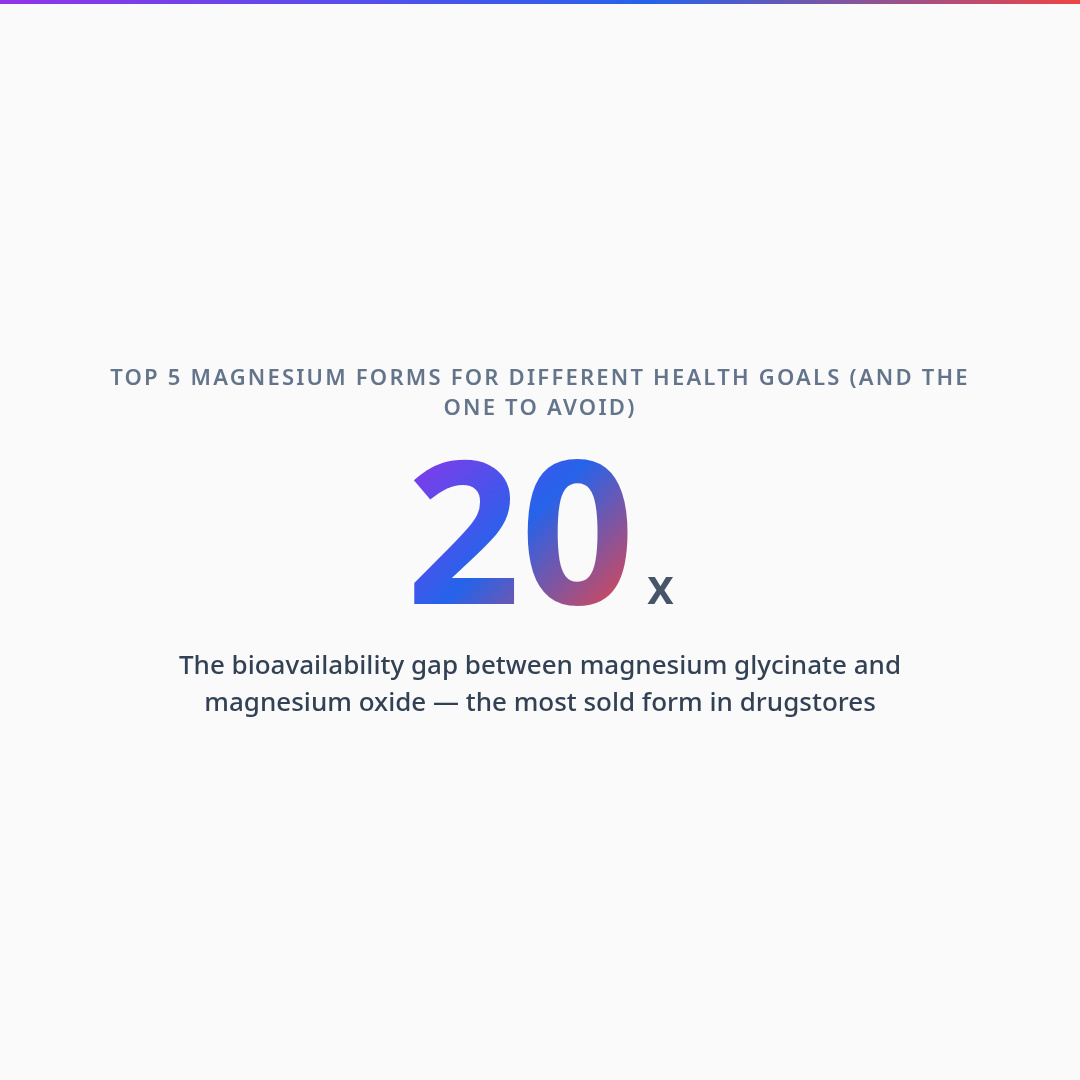
Magnesium oxide is the most commonly sold magnesium supplement in pharmacies and drug stores. It is also, by a significant margin, the worst-absorbed form available. Studies show absorption rates as low as 4% — compared to roughly 80% for glycinate. At the doses typically sold (400–500 mg per tablet), a patient taking oxide absorbs approximately 16–20 mg of elemental magnesium. The same dose of glycinate delivers 320 mg of absorbed magnesium.
This is the 20x gap referenced in the quick stat above. A patient can take magnesium oxide every day for months and never meaningfully raise their magnesium status.
| Factor | Magnesium Oxide | Magnesium Glycinate |
|---|---|---|
| Absorption Rate | ~4% | ~80% |
| Absorbed Mg from 400mg dose | ~16 mg | ~320 mg |
| Laxative Effect | Strong at any dose | Minimal |
| Sleep Support Evidence | Indirect only | Direct (glycine + magnesium) |
| Cost per effective dose | Appears cheap; poor value | Higher cost; far better value |
| FormulaForge Tier | T3 (Customer Choice) | T1 (Preferred) |
Why is oxide so prevalent? Because it contains the highest percentage of elemental magnesium by weight of any form — roughly 60%. This looks impressive on a supplement facts panel: "500 mg magnesium" as oxide appears to deliver more than "500 mg magnesium" as glycinate, which only contains about 14% elemental magnesium by weight. Manufacturers know that most consumers read the milligram number on the label without understanding that unabsorbed magnesium has no physiological value.
The oxide form does have one legitimate clinical application: acute constipation relief. As a laxative, its osmotic properties are well-documented and intentional. But for any patient taking magnesium to support sleep, muscle function, cardiovascular health, or cognitive performance, oxide is the wrong choice.
Magnesium oxide was the form used in many early clinical trials on magnesium supplementation. Some practitioners still cite those studies to justify magnesium's effects — but the modest outcomes of those trials may partly reflect poor absorption from the oxide form used. Trials using glycinate or malate at equivalent absorbed doses often show stronger results.
You buy the magnesium recommended on the pharmacy shelf — it says 500 mg on the label. You take it faithfully for three months. Nothing changes. You conclude magnesium "doesn't work for you." But you were absorbing roughly 20 mg per dose. You were never actually supplementing.
Match the form to your goal. Sleep: glycinate. Energy and fibromyalgia: malate. Brain health: threonate. Heart: taurate. General correction: citrate. All five of these deliver absorbed, bioavailable magnesium. The form is not a minor detail — it is the primary variable that determines whether supplementation works.
How to Choose the Right Form for Your Patient (or Yourself)
The practical framework I use in clinical practice breaks down like this:
- Sleep complaint + anxiety: Start with glycinate, 300–400 mg elemental magnesium, taken 1–2 hours before bed. Add glycine separately if anxiety is severe.
- Fatigue + fibromyalgia: Malate is the first choice, taken with meals to support energy metabolism during the day. Do not take malate at bedtime if the patient is already dealing with insomnia — the malic acid component is energizing.
- Cognitive complaints in a patient over 50: Threonate as primary for CNS delivery, with glycinate or malate secondary to cover total magnesium needs.
- Hypertension or palpitations: Taurate is preferred; coordinate with the patient's cardiologist on any cardiac application.
- General deficiency without specific symptoms: Citrate is cost-effective and well-studied. Upgrade to glycinate if budget allows or if any of the above complaints are present.
- Patient currently taking oxide: Switch immediately to any of the above five forms. Almost any alternative is a significant upgrade.
Every magnesium form in the FormulaForge formulary is classified by its bioavailability tier, co-factor profile, and clinical indication. When you analyze a supplement label at myformulaforge.com, the system identifies which form of magnesium your current product contains, flags whether it matches your stated health goals, and — if you are in a multi-supplement stack — checks for duplicate magnesium sources across all your bottles. The goal is simple: make sure the form you are paying for is the form your body can actually use.
The tolerable upper intake level (UL) for supplemental magnesium is 350 mg/day for adults (this applies to supplemental forms only, not dietary magnesium). Doses above this threshold increase the risk of diarrhea, nausea, and in rare cases with very high doses and compromised kidney function, more serious adverse effects. Individuals with kidney disease should consult a physician before taking any supplemental magnesium. All dosing information in this article reflects elemental magnesium content, not the total weight of the supplement form.
Frequently Asked Questions
Magnesium is one of the most important minerals in human physiology, involved in over 300 enzymatic reactions. The science on form selection is clear: glycinate for sleep and anxiety, malate for energy and fibromyalgia, threonate for cognitive health, taurate for cardiovascular support, and citrate for general correction. Oxide is not a therapeutic supplement — it is a laxative with marketing copy. Choosing the right form is not a nuance. It is the difference between a supplement that works and one that does not.
This article is intended for educational and informational purposes only and does not constitute medical advice. The information provided here is not a substitute for professional medical advice, diagnosis, or treatment. Always seek the guidance of your physician or other qualified health provider with any questions you may have regarding a medical condition or supplement regimen. These statements have not been evaluated by the Food and Drug Administration. Dietary supplements are not intended to diagnose, treat, cure, or prevent any disease.
- Abbasi B, et al. The effect of magnesium supplementation on primary insomnia in elderly: A double-blind placebo-controlled clinical trial. J Res Med Sci. 2012;17(12):1161–1169.
- Abraham GE, Flechas JD. Management of fibromyalgia: rationale for the use of magnesium and malic acid. J Nutr Med. 1992;3(1):49–59.
- Slutsky I, et al. Enhancement of synaptic plasticity through chronically reduced Ca2+ flux during uncorrelated activity. Neuron. 2010;65(2):165–177.
- Liu G, et al. Efficacy and safety of MMFS-01, a synapse density enhancer, for treating cognitive impairment in older adults: A randomized, double-blind, placebo-controlled trial. J Alzheimers Dis. 2016;49(4):971–990.
- Shechter M, et al. Comparison of magnesium status using X-ray dispersion analysis following magnesium oxide and magnesium citrate treatment of healthy subjects. Magnes Res. 2012;25(1):28–39.
- Walker AF, et al. Mg citrate found more bioavailable than other Mg preparations in a randomised, double-blind study. Magnes Res. 2003;16(3):183–191.

Related Research
- ResearchMagnesium Bisglycinate Chelate (TRAACS®) — Forms, Dosing & Research(1 form)
- ResearchMagnesium (as Magnesium L-Threonate) — Forms, Dosing & Research(1 form)
- ResearchMagnesium (as Magnesium Taurinate) — Forms, Dosing & Research(1 form)
- ResearchMagnesium (as DiMagnesium Malate) — Forms, Dosing & Research(1 form)