Iron Supplements: The Hidden Quality Crisis
**Meta Description:** Learn the truth about iron supplements—most fail quality tests. Discover how to identify high-quality iron, avoid toxic contaminants, and optimize absorption for real results. --- You've been taking your iron supplement rel...

D.C.
Doctor of Chiropractic
Founder of FormulaForge. Doctor of Chiropractic revolutionizing nutritional supplements to be what we all wish they were — real quality, scientifically validated, with the exact ingredients and dosages we choose.
View Full ProfileReviewed by Dr. Brennan Commerford, DC
Iron deficiency is the most prevalent nutritional deficiency worldwide — yet the most commonly sold iron supplement form (ferrous sulfate) causes significant GI side effects in a large proportion of patients, and many women with documented deficiency quietly stop taking their supplements because the experience is intolerable. This guide explains why most iron products are made with cheap, poorly-tolerated forms, what bisglycinate actually changes, how absorption co-factors work, and why women's iron supplementation has been systematically underserved by an industry that has not prioritized their experience.
The Iron Quality Problem Nobody Talks About
Iron deficiency anemia is among the most clinically important nutritional conditions I encountered in practice. Symptoms — fatigue, cognitive fog, hair thinning, breathlessness, restless legs, cold hands and feet — are real, measurable, and significantly reduce quality of life. The standard clinical recommendation is iron supplementation. The patient goes to the pharmacy, purchases a bottle of ferrous sulfate, takes it for a week, experiences nausea and constipation, and quietly stops.
This pattern is not a personal failure. It is a quality failure. Ferrous sulfate is chosen by manufacturers because it is cheap, concentrated, and has been the standard for decades. Not because it is the best tolerated or the most effective at raising iron stores. Better forms exist — they have been well-studied, they have far superior GI tolerability profiles, and they often achieve comparable or better iron repletion outcomes at lower elemental iron doses. But they cost more to produce, and the supplement industry has largely not prioritized the patient experience in iron supplementation.
Iron deficiency is the leading cause of anemia globally, affecting an estimated 2 billion people. In the United States, approximately 10 million people are iron deficient, with women aged 15–49 representing the highest-risk group due to menstrual blood loss. Despite this prevalence, iron supplementation adherence rates are poor — studies consistently find that 30–70% of patients discontinue ferrous sulfate within 30 days due to GI adverse effects. This is a clinical failure with public health consequences.
Iron Forms: What Is Actually in the Bottle
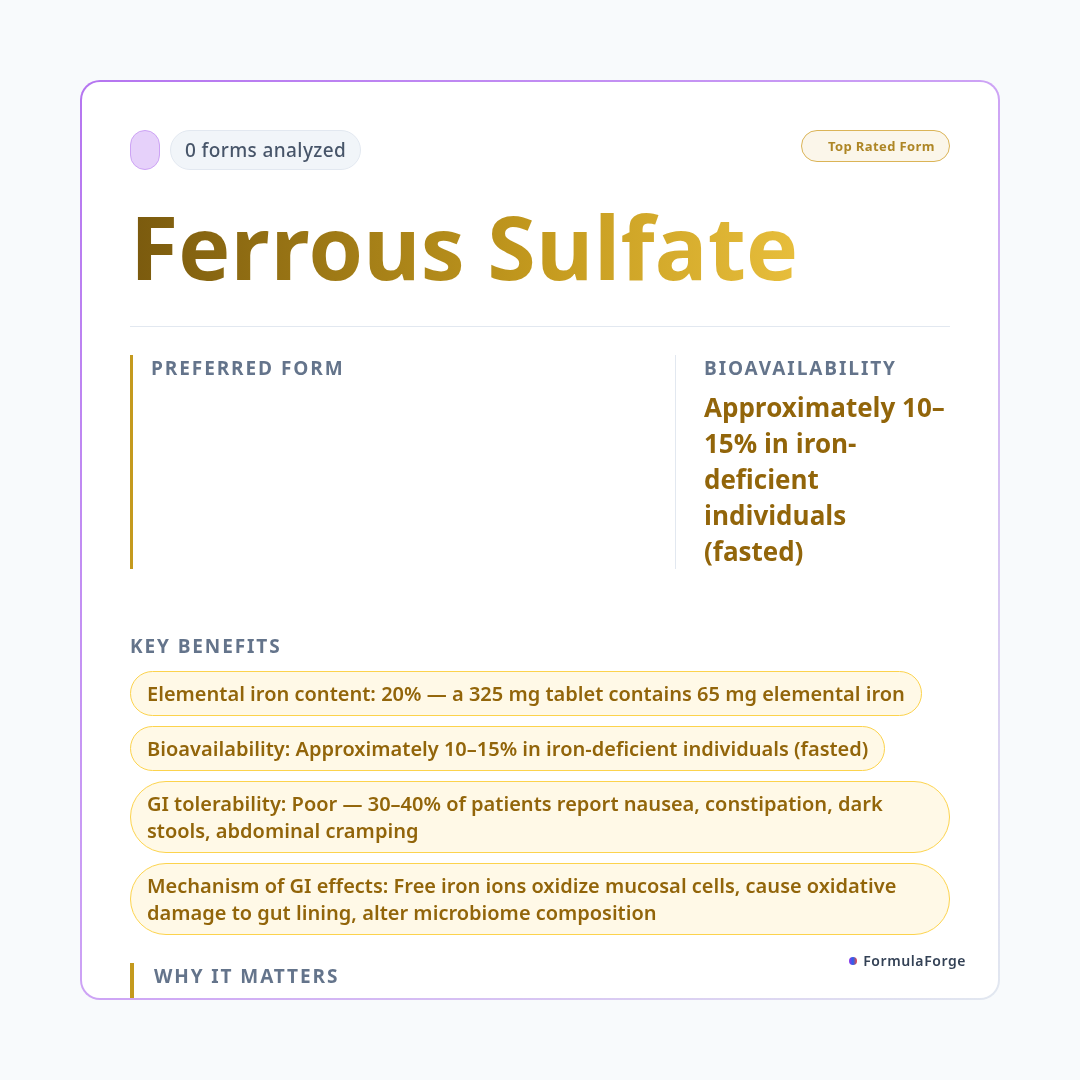
Not all iron compounds are equivalent — not in elemental content, not in bioavailability, and not in tolerability. Understanding these differences is the first step to making an intelligent supplementation decision.
Why Bisglycinate Is Different: The Chelate Mechanism
The key distinction between ferrous bisglycinate and inorganic iron salts is not just chemical — it is mechanistic. Understanding how bisglycinate is absorbed explains both why it is better tolerated and why it achieves equivalent outcomes at lower doses.
Ferrous sulfate dissociates in the stomach, releasing free ferrous ions (Fe2+). These ions are absorbed via the divalent metal transporter 1 (DMT1) in the duodenum. The free iron that is not absorbed sits in the intestinal lumen and colon, where it generates reactive oxygen species through the Fenton reaction, oxidizes mucosal cells, and disrupts the intestinal microbiome. This is the direct mechanism of ferrous sulfate's GI side effects: the unabsorbed free iron is actively damaging the gut.
Iron bisglycinate (iron chelated to two glycine molecules) does not dissociate in the stomach the way ionic forms do. The iron remains bound to glycine and is absorbed via the peptide transporter 1 (PepT1) pathway — the same pathway used to absorb dietary dipeptides and tripeptides. This means: the iron never exists as a free ion in the gut lumen, no oxidative damage to the intestinal mucosa, no disruption of the colonic microbiome, and improved absorption independent of the DMT1 transporter. The result is a higher proportion absorbed, less unabsorbed iron causing damage, and dramatically better GI tolerability.
A 2014 randomized controlled trial in Nutrients compared ferrous bisglycinate chelate (27 mg elemental iron) to ferrous fumarate (65 mg elemental iron) in women with iron deficiency. After 90 days, standard iron status markers showed comparable results between groups — despite the bisglycinate group receiving 58% less elemental iron. GI adverse events were significantly lower in the bisglycinate group (p less than 0.001). A 2019 meta-analysis confirmed that iron bisglycinate chelate achieves comparable hemoglobin improvement to standard ionic iron at lower doses with significantly better tolerability.
Absorption Co-factors: What Helps and What Blocks
Iron absorption is highly context-dependent. Understanding the factors that enhance or block absorption is as important as choosing the right form.
The standard protocol for maximum iron absorption: take iron on an empty stomach in the morning, with 100–200 mg Vitamin C, and wait at least 1 hour before coffee or dairy. However, for patients who cannot tolerate iron on an empty stomach, iron bisglycinate with a small meal is a clinically acceptable compromise — the chelated form retains meaningful absorption even with some food present, unlike ferrous sulfate.
The Women's Health Gap in Iron Supplementation
Iron deficiency is predominantly a women's health issue in developed countries. Menstrual blood loss, pregnancy, and breastfeeding create iron demands that dietary intake frequently cannot meet. Yet the iron supplement market has largely not innovated for the women who are its primary consumers. The dominant products are still high-dose ferrous sulfate tablets designed decades ago — optimized for maximum elemental iron on paper, not for the patient experience.
Studies of iron supplementation adherence consistently find that 30–70% of patients discontinue ferrous sulfate within the first month due to GI side effects. In pregnancy, where iron needs are highest (27 mg/day RDA vs. 18 mg/day for non-pregnant women), poor tolerability is especially problematic. A patient who cannot tolerate her iron supplement and quietly stops taking it has worse iron status outcomes than if she had been prescribed a well-tolerated lower-dose bisglycinate product from the start.
Iron bisglycinate chelate at 14–27 mg elemental iron per dose, with Vitamin C included in the formula, taken with or without food depending on individual tolerance. This approach achieves equivalent ferritin repletion to 65 mg ferrous sulfate in controlled trials, produces dramatically fewer GI side effects, maintains adherence, and treats the patient's experience as a clinical variable rather than an afterthought. It is not currently the market default — but it should be.
A landmark 2017 study in The Lancet Haematology by Moretti et al. found that alternate-day iron dosing (every other day rather than daily) reduced hepcidin elevation and increased the proportion of each dose absorbed in iron-deficient women. Fractional iron absorption was 40% higher on alternate-day dosing compared to consecutive daily dosing. This finding challenged the decades-old standard of daily iron supplementation and suggests that less frequent, well-tolerated dosing may achieve better outcomes than high-dose daily sulfate protocols that patients cannot sustain.
Ferritin: The Marker That Actually Matters
Serum ferritin is the primary storage marker for iron — it reflects iron stores in bone marrow, liver, and spleen, not just circulating iron. Understanding ferritin thresholds is essential for assessing iron status:
Ferritin is an acute phase reactant — it rises during inflammation regardless of iron stores. A high ferritin in the context of infection, inflammatory disease, or metabolic syndrome does not confirm adequate iron. Conversely, iron overload (hereditary hemochromatosis, excessive supplementation) is associated with liver damage, cardiac dysfunction, and joint disease. Never supplement iron without confirming documented deficiency via blood testing. Iron supplementation in iron-replete individuals is not beneficial and may be harmful.
Dosing: Lower Than You Think With the Right Form
Iron form identification is one of the most impactful analyses in the FormulaForge system. When you analyze a supplement at myformulaforge.com, the system identifies whether your iron source is ferrous sulfate, fumarate, bisglycinate, or a ferric form — and gives you an honest assessment of the expected tolerability and relative absorption efficiency. For patients in the FormulaForge system who are managing iron deficiency with a supplement stack, the analysis also checks for calcium timing conflicts and Vitamin C co-factor presence, two of the most common reasons iron therapy underperforms.
Iron is one of the few minerals where excess supplementation causes serious harm. Accidental iron poisoning is a leading cause of fatal pediatric poisoning — keep all iron supplements locked away from children. In adults, chronic iron overload damages the liver, heart, and joints. Never supplement iron without laboratory confirmation of deficiency (serum ferritin below 30 ng/mL, ideally below 12 ng/mL for clear deficiency). The upper tolerable limit for supplemental iron is 45 mg/day for adults; therapeutic doses above this require medical supervision. Patients with hereditary hemochromatosis must not take iron supplements.
Frequently Asked Questions
Iron deficiency is real, common, and undertreated — partly because the standard supplement (ferrous sulfate) causes side effects severe enough that patients stop taking it. Iron bisglycinate chelate achieves equivalent or better ferritin repletion at significantly lower elemental iron doses with dramatically better GI tolerability. The evidence supports 14–27 mg/day of bisglycinate (not 65 mg ferrous sulfate) as the appropriate starting point for most iron-deficient women without anemia. Always confirm deficiency with a ferritin test before supplementing. Take iron with Vitamin C, away from calcium and coffee, in the morning. The right form at the right time for the right patient is how iron supplementation actually works.
This article is intended for educational and informational purposes only and does not constitute medical advice. The information provided here is not a substitute for professional medical advice, diagnosis, or treatment. Always seek the guidance of your physician or other qualified health provider with any questions you may have regarding a medical condition or supplement regimen. Iron supplementation without confirmed deficiency via laboratory testing is not recommended. These statements have not been evaluated by the Food and Drug Administration. Dietary supplements are not intended to diagnose, treat, cure, or prevent any disease.
- Milman N, et al. Iron absorption from ferrous bisglycinate chelate versus ferrous fumarate in pregnant women. Nutrients. 2014;6(8):3052–3059.
- Moretti D, et al. Oral iron supplements increase hepcidin and decrease iron absorption from daily or twice-daily doses in iron-depleted young women. Blood. 2015;126(17):1981–1989.
- Moretti D, et al. Increasing iron absorption from a plant-based diet and non-daily supplementation of young women. Lancet Haematol. 2017;4(8):e334–e348.
- Hallberg L, et al. Calcium: effect of different amounts on nonheme- and heme-iron absorption in humans. Am J Clin Nutr. 1991;53(1):112–119.
- Hurrell RF, et al. Inhibition of non-haem iron absorption in man by polyphenolic-containing beverages. Br J Nutr. 1999;81(4):289–295.
- Solomons NW, et al. Interaction of iron and zinc in the gut: a second look at clinical significance. J Nutr. 1994;124(8 Suppl):1543S–1547S.
- Cook JD, et al. Vitamin C, the common cold, and iron absorption. Am J Clin Nutr. 1977;30(2):235–241.
Related Research
- ResearchIron (as Ferrous Bisglycinate Chelate) (Ferrochel®) — Forms, Dosing & Research(1 form)
- ResearchIonic Plant-Based Trace Minerals — Forms, Dosing & Research(1 form)
- ResearchIron Glycinate (non-Ferrochel) — Forms, Dosing & Research(1 form)
- ResearchBHB Mineral Salts (generic) — Forms, Dosing & Research(1 form)