The Best-Researched Ingredients for Sleep Support: What the Science Actually Says
Everyone recommends melatonin, but the research on sleep support goes much deeper. Here is what the science actually says about five key ingredients.

D.C.
Doctor of Chiropractic
Founder of FormulaForge. Doctor of Chiropractic revolutionizing nutritional supplements to be what we all wish they were — real quality, scientifically validated, with the exact ingredients and dosages we choose.
View Full ProfileReviewed by Dr. Brennan Commerford, DC
Most adults reaching for a sleep supplement grab melatonin — and most are taking it wrong. The research on sleep support spans a broader landscape than any single ingredient, including magnesium, L-theanine, ashwagandha, GABA, and melatonin itself. This article surveys each with a critical eye on the evidence, separates the well-supported from the overhyped, and clarifies the doses and combinations that research suggests are most effective. The goal is not to tell you what to take — it is to give you the science to make that decision yourself.
Everyone Recommends Melatonin. The Research on Sleep Support Is Much Deeper Than That.
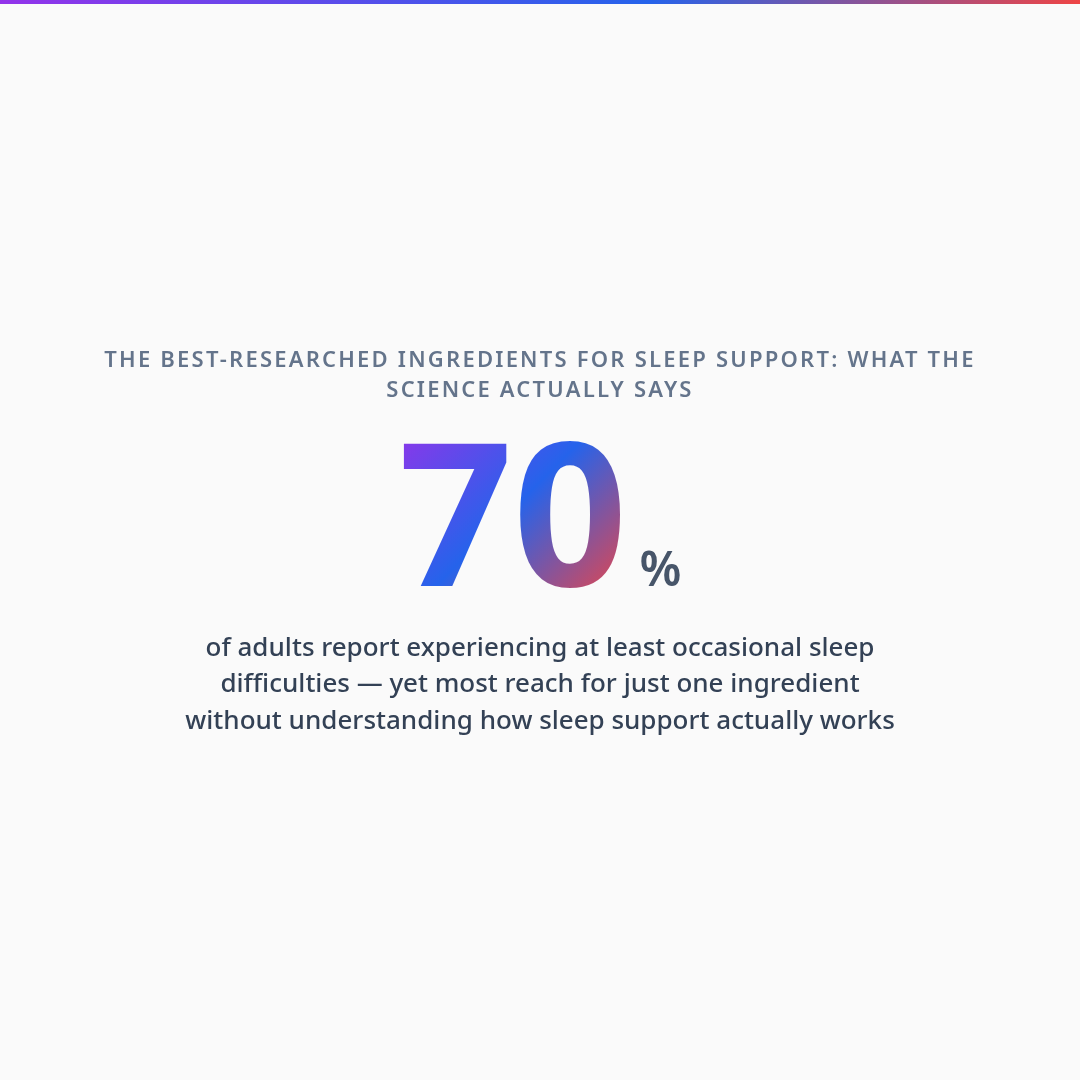
Melatonin became the default sleep supplement recommendation largely because it was the first sleep-related compound to be sold over-the-counter at scale. It has become a category, not just a product — and that has created a problem. Patients take 10 mg doses when the research supports 0.3–0.5 mg. They take it at the wrong time. And they miss the ingredients with arguably stronger evidence for the most common sleep complaints: difficulty falling asleep, waking through the night, and restless, non-restorative sleep driven by stress and anxious rumination.
In practice, the most effective sleep support protocols I have observed are multi-targeted, not single-ingredient. Sleep architecture involves multiple neurotransmitter systems: GABAergic inhibition, serotonin-melatonin pathway, cortisol-HPA axis regulation, and magnesium-dependent enzymatic calming. Targeting only one of these while leaving the others unaddressed is why many patients report that sleep supplements "work for a few days and then stop."
This guide surveys the five best-researched sleep support ingredients, explains the mechanism behind each, summarizes the clinical evidence, and gives you a framework for thinking about them together — not just separately.
1. Magnesium Glycinate — The Foundation of Any Sleep Protocol
If there is one ingredient that belongs in virtually every sleep-focused formulation, it is magnesium glycinate. The rationale spans multiple mechanisms: magnesium is a cofactor for over 300 enzymatic reactions, including those that regulate GABA activity, cortisol production, and the conversion of tryptophan to serotonin. Most adults are deficient. The glycinate form delivers calming glycine alongside the magnesium in a highly bioavailable chelate that does not cause the GI distress that limits other forms.
Glycine itself has an independent body of evidence. As an inhibitory neurotransmitter acting at NMDA receptors, glycine taken at bedtime reduces core body temperature (a physiological prerequisite for sleep onset), shortens sleep onset latency, and reduces daytime fatigue from poor sleep. When combined with magnesium in the glycinate form, you are supporting sleep from two converging pathways simultaneously.
A double-blind, placebo-controlled trial published in Sleep and Biological Rhythms (Bannai et al., 2012) found that 3 grams of glycine taken before bed significantly improved subjective sleep quality, reduced time to sleep onset, and lowered daytime sleepiness as measured by the Epworth Sleepiness Scale. The mechanism involved reduction of core body temperature, not sedation. Magnesium glycinate delivers this glycine alongside one of the most bioavailable forms of magnesium available.
For the majority of patients presenting with sleep complaints, magnesium glycinate is the first ingredient to add, not the last. It provides a physiological foundation on which the other sleep-support compounds act more effectively. Deficiency in magnesium impairs the GABA system — which is the primary target of the most prescribed sleep medications. Correcting that deficiency changes the baseline from which everything else operates.
Mechanism: GABA cofactor activity, cortisol regulation, glycine NMDA modulation, core body temperature reduction.
Research-supported dose: 300–400 mg elemental magnesium as glycinate, taken 1–2 hours before bed.
Form matters: Oxide and citrate do not deliver glycine and have significantly lower absorption. Glycinate is the specific form with sleep-support evidence.
2. L-Theanine — The Calming Amino Acid Without the Sedation
L-theanine is an amino acid found almost exclusively in tea leaves — particularly green tea — where it is believed to account for the paradoxical calm-alertness that tea drinkers experience despite the caffeine content. At supplemental doses, theanine promotes alpha brainwave activity (the waveform associated with relaxed alertness and the transitional state before sleep), reduces perceived stress and anxiety, and modulates glutamate and GABA activity without producing sedation on its own.
This last point is important. Theanine does not make you drowsy in the way that sedating compounds do. It does not impair cognition or motor function. It shifts the neurological state toward calm without forcing sleep — which means it is effective in patients who struggle to fall asleep due to racing thoughts or anxiety, without the grogginess-the-next-morning profile that concerns many patients about heavier sleep aids.
A randomized, double-blind, placebo-controlled study published in Nutrients (Williams et al., 2016) found that 200 mg of L-theanine significantly improved sleep quality and reduced sleep disturbance in adults with generalized anxiety disorder. Separate studies in healthy volunteers show that a single 200 mg dose increases alpha activity within 30–40 minutes. A 2019 study in Nutrients (Hidese et al.) found that 200 mg/day over four weeks improved sleep quality, sleep latency, and next-day alertness compared to placebo.
The combination of L-theanine and magnesium glycinate is particularly well-supported. Magnesium addresses the physiological substrate (GABA cofactor activity, cortisol regulation), while theanine reduces the cognitive-emotional activation that prevents sleep onset in anxious patients. These two ingredients work on complementary pathways — which is why the combination produces results that either alone often does not.
Mechanism: Alpha brainwave promotion, glutamate modulation, GABA support, anxiolytic without sedation.
Research-supported dose: 100–200 mg, taken 30–60 minutes before bed.
Note: Theanine's effects are dose-dependent. Some patients report better results at 200 mg; studies in anxious individuals tend to use this higher dose.
3. Ashwagandha (KSM-66) — For Stress-Driven Insomnia
Not all insomnia is created by the same mechanism. For patients whose sleep difficulty is primarily stress-driven — cortisol that will not come down at night, wired-but-tired presentation, difficulty disengaging from work or worry — ashwagandha addresses a root cause that glycinate and theanine do not directly target: HPA axis dysregulation.
Ashwagandha is an adaptogenic root with a substantial body of human clinical trial data. Its primary bioactive compounds — withanolides, including withaferin A and withanolide D — appear to modulate the HPA axis response, reduce cortisol levels, and improve both subjective stress and objective physiological stress markers. Sleep benefits appear to be largely downstream of this cortisol regulation.
Form matters significantly for ashwagandha. KSM-66 is a full-spectrum root extract standardized to at least 5% withanolides, and it is the form used in the majority of the positive clinical trials. Sensoril is an alternative extract with slightly different withanolide profiles and comparable evidence. Generic "ashwagandha root powder" is not equivalent — the withanolide content varies widely and the majority of clinical outcomes cannot be attributed to unstandardized preparations.
A randomized, double-blind trial published in Medicine (Langade et al., 2019) found that KSM-66 ashwagandha at 300 mg twice daily for 10 weeks significantly improved all sleep quality parameters measured by polysomnography — including total sleep time, sleep efficiency, sleep onset latency, and wake after sleep onset — compared to placebo. Crucially, the researchers attributed the improvement to cortisol normalization rather than direct sedation, which means the mechanism is restorative, not suppressive.
Ashwagandha requires consistent, multi-week use to show full effect. Patients expecting results the first night will be disappointed. The adaptogenic mechanism is cumulative — it recalibrates HPA axis reactivity over time rather than producing an acute sedative response. For patients with chronic stress-related insomnia, this is actually preferable: the goal is a normal cortisol rhythm, not pharmacological suppression.
Mechanism: HPA axis modulation, cortisol reduction, stress-adaptive response normalization.
Research-supported dose: 300–600 mg of KSM-66 daily (some protocols split AM/PM; sleep-specific trials often use a single evening dose).
Timeline: Allow 4–8 weeks for full effect. Sleep improvements may begin within 2–3 weeks.
4. GABA — The Inhibitory Neurotransmitter
GABA (gamma-aminobutyric acid) is the primary inhibitory neurotransmitter in the central nervous system. Reduced GABA activity is directly implicated in anxiety disorders and insomnia, and virtually every pharmaceutical sleep aid and anti-anxiety medication targets some component of the GABA system — either GABAergic receptors directly (benzodiazepines, z-drugs) or indirectly through other mechanisms.
The question with supplemental GABA has historically been whether orally ingested GABA crosses the blood-brain barrier in meaningful amounts. Early pharmacokinetic models suggested it did not. More recent evidence suggests the picture is more nuanced: some GABA crosses, and peripheral GABA receptors in the enteric nervous system and vagal nerve pathway may mediate effects without requiring CNS penetration.
A Pharma GABA (a naturally fermented form) study published in Amino Acids (Abdou et al., 2006) found that 100 mg of oral GABA increased alpha brainwave activity and reduced beta (alertness) activity within 60 minutes, with effects similar to what was observed with L-theanine. Separate work has shown Pharma GABA to reduce task-related stress and subjective anxiety in controlled conditions.
The honest assessment of oral GABA is that the evidence base is growing but remains thinner than for glycinate, theanine, or KSM-66 ashwagandha. It is a legitimate sleep support ingredient with plausible mechanisms, not one with the depth of clinical trials supporting the top three. In combination formulations targeting GABA activity, it may provide additive benefit — particularly when stacked with magnesium (a GABA cofactor) and theanine (a GABA modulator).
Mechanism: Direct GABAergic activity, peripheral enteric and vagal GABA receptor engagement, alpha brainwave promotion.
Research-supported dose: 100–500 mg (Pharma GABA form preferred in studies).
Consideration: Dosing above 500 mg has been associated with mild tingling sensations in some studies; generally well-tolerated below this threshold.
5. Melatonin — The Most Popular, Most Misunderstood Sleep Supplement
Melatonin is a pineal gland hormone that regulates circadian rhythm. It is not a sedative. This is the central misunderstanding that leads most people to take it incorrectly — at the wrong dose, at the wrong time, and with the wrong expectations.
Melatonin tells your body it is night. It shifts the circadian phase. It prepares the physiological conditions for sleep onset. It does not knock you out. If you have normal melatonin physiology and you are taking melatonin hoping to fall asleep faster on a stressed night, you are using a circadian signal as a pharmacological sedative — and it will not work reliably for that purpose.
The evidence-based use cases for melatonin are: circadian phase disorders (jet lag, shift work, delayed sleep phase disorder), sleep onset in older adults whose endogenous melatonin production has declined, and pediatric sleep onset disorders. For these applications, the research is robust.
Most commercial melatonin products are sold at 5 mg or 10 mg doses. The research supporting melatonin efficacy primarily uses doses of 0.3–0.5 mg. Supraphysiological doses (5–10 mg) can desensitize melatonin receptors over time, disrupt natural melatonin rhythm, and are associated with morning grogginess and vivid dreaming. Studies indicate that 0.5 mg is as effective as 3 mg for sleep onset latency, with a substantially better side effect profile. If you are taking 10 mg melatonin nightly, you are very likely taking 20–33x the effective dose.
The timing issue is equally important. Melatonin is most effective when taken 30–60 minutes before your target sleep time, timed to begin the phase-shifting signal. Taking it in response to lying in bed unable to sleep is too late — the signal has already been missed for that evening's circadian window.
For patients whose primary complaint is not circadian disruption but rather anxiety-driven sleep difficulty, stress-driven insomnia, or poor sleep quality, melatonin is less important than the previous four ingredients. It may play a supporting role at physiological doses (0.3–0.5 mg), but it should not be the headline ingredient in a sleep protocol unless circadian dysregulation is the documented primary cause.
Mechanism: Circadian phase regulation, MT1/MT2 receptor activation, temperature regulation signaling.
Evidence-based dose: 0.3–0.5 mg, taken 30–60 minutes before target sleep time.
Avoid: Doses above 1 mg for routine use unless under medical guidance for a specific circadian disorder.
All Five at a Glance
| Ingredient | Primary Mechanism | Best For | Onset | Evidence Strength |
|---|---|---|---|---|
| Magnesium Glycinate | GABA cofactor, glycine NMDA modulation | Foundation support, muscle relaxation, deficiency correction | 2–4 weeks | Strong |
| L-Theanine | Alpha brainwave promotion, glutamate modulation | Racing thoughts, anxiety-driven sleep difficulty | 30–60 min (acute) | Strong |
| Ashwagandha KSM-66 | HPA axis modulation, cortisol reduction | Stress-driven insomnia, wired-but-tired | 4–8 weeks | Strong |
| GABA (Pharma) | GABAergic receptor activity, peripheral vagal pathway | Additive GABA support in combination formulas | 30–60 min | Moderate |
| Melatonin | Circadian phase regulation | Jet lag, shift work, delayed sleep phase, older adults | 30–60 min | Strong (for circadian use) |
You take melatonin for sleep. Sometimes it works, sometimes it does not. You add magnesium — from a bottle of oxide you already had. You pick up GABA at the health food store. You are now juggling three separate bottles, taking them at different times, unsure which one is doing what or whether the doses are right. Total monthly cost: $60–90. Pill burden: 4–6 capsules per night. Overlap and gaps: completely opaque.
You choose the combination and the dose — your way. If you want glycinate, theanine, and ashwagandha in a single nightly formula, you build that. If you want to add GABA at a specific dose, you control that too. Your formula is one bottle, not three. The ingredients match your goals. The doses match the research. And if your needs change — say, you travel frequently and need melatonin in the mix — you adjust the formula. That is what personalized supplementation means.
When you build a sleep support formula at myformulaforge.com, the ingredient library includes magnesium glycinate (T1 preferred), L-theanine, ashwagandha KSM-66, Pharma GABA, and melatonin — each at research-supported dose ranges that you control. The platform flags if you are already getting any of these ingredients in existing supplement bottles you have scanned, preventing duplication. You choose the combination. You set the doses. We formulate it as one clean product. No bottle sprawl. No redundant spending. No guessing about forms.
Frequently Asked Questions
Sleep is not a single-molecule problem. The research supports a multi-targeted approach: magnesium glycinate as the foundational mineral substrate, L-theanine for cognitive calm at sleep onset, ashwagandha KSM-66 for stress-driven cortisol dysregulation, GABA for additional inhibitory support, and melatonin at physiological doses for circadian regulation when indicated. Melatonin at 10 mg is not the answer. A research-matched, appropriately combined formula — at doses you choose — is a meaningfully different approach, and the science behind it is not new. It is just not what gets shelved at eye level in the drugstore.
This article is intended for educational and informational purposes only and does not constitute medical advice. The information provided here is not a substitute for professional medical advice, diagnosis, or treatment. Always seek the guidance of your physician or other qualified health provider with any questions you may have regarding a medical condition, sleep disorder, or supplement regimen. These statements have not been evaluated by the Food and Drug Administration. Dietary supplements are not intended to diagnose, treat, cure, or prevent any disease. Consult your healthcare provider before beginning any supplementation protocol, particularly if you take medications or have a diagnosed sleep or anxiety disorder.
- Bannai M, et al. The effects of glycine on subjective daytime performance in partially sleep-restricted healthy volunteers. Sleep Biol Rhythms. 2012;10(2):105–112.
- Williams JL, et al. L-theanine as a functional food additive: Its role in disease prevention and health promotion. Nutrients. 2016;8(3):166.
- Hidese S, et al. Effects of L-theanine administration on stress-related symptoms and cognitive functions in healthy adults: A randomized controlled trial. Nutrients. 2019;11(10):2362.
- Langade D, et al. Efficacy and safety of Ashwagandha (Withania somnifera) root extract in insomnia and anxiety: A double-blind, randomized, placebo-controlled study. Medicine (Baltimore). 2019;98(37):e17186.
- Abdou AM, et al. Relaxation and immunity enhancement effects of gamma-aminobutyric acid (GABA) administration in humans. Biofactors. 2006;26(3):201–208.
- Brzezinski A, et al. Effects of exogenous melatonin on sleep: A meta-analysis. Sleep Med Rev. 2005;9(1):41–50.
- Lewy AJ, et al. Low, but not high, doses of melatonin entrained a free-running blind person with a long circadian period. Chronobiol Int. 2002;19(3):649–658.
Related Research
- ResearchAshwagandha (Withania somnifera) Root Extract — Forms, Dosing & Research(1 form)
- ResearchMagnesium Bisglycinate Chelate (TRAACS®) — Forms, Dosing & Research(1 form)
- ResearchAshwagandha Root Powder (Whole Root) — Forms, Dosing & Research(1 form)
- ResearchMagnesium (as Magnesium L-Threonate) — Forms, Dosing & Research(1 form)