Anti-Aging Supplements: What Actually Works in 2026
## Meta Description Learn the truth about anti-aging supplements: search +102%. Discover what works, what doesn't, and how to verify quality before you buy. --- You're standing in the supplement aisle, staring at bottles promising "youthful vita...

D.C.
Doctor of Chiropractic
Founder of FormulaForge. Doctor of Chiropractic revolutionizing nutritional supplements to be what we all wish they were — real quality, scientifically validated, with the exact ingredients and dosages we choose.
View Full ProfileReviewed by Dr. Brennan Commerford, DC
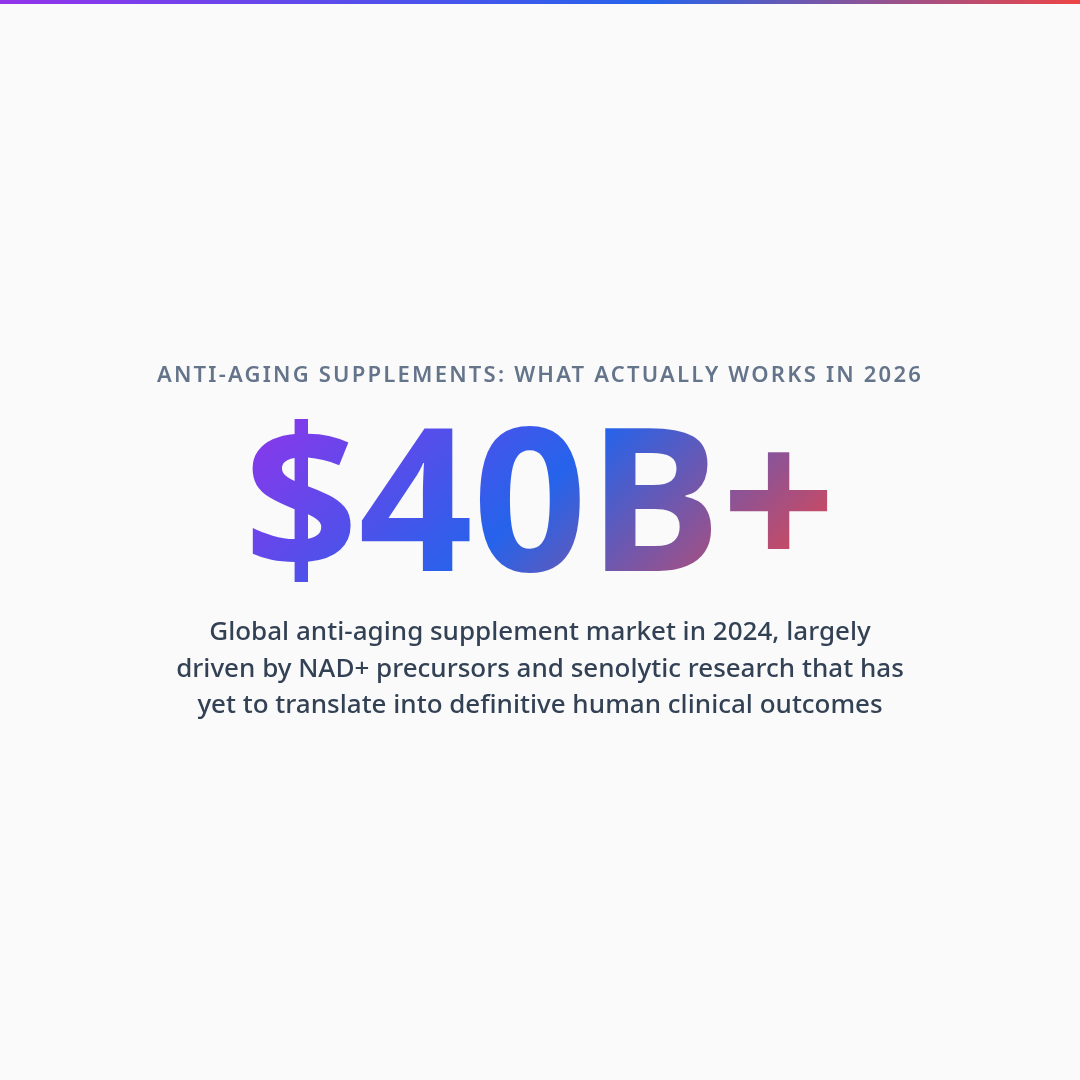
The anti-aging supplement market generated over $40 billion globally in 2024, much of it built on mechanisms that are real but clinical outcomes that remain unproven. This guide applies rigorous evidence tiers to five of the most popular anti-aging supplements — NMN, Resveratrol, CoQ10, Quercetin, and Spermidine — separating what the research actually shows from what supplement companies want you to believe. The goal is not to dismiss these compounds; several have genuine clinical merit. The goal is precision: the right supplement, the right dose, the right expectations.
The Evidence Gap in Anti-Aging Supplementation
Longevity research has produced genuinely exciting mechanisms over the past decade. Sirtuins, NAD+ metabolism, mTOR signaling, senolytics, and autophagy all represent real biological pathways with legitimate involvement in the aging process. The frustration for clinicians and informed consumers is that the gap between mechanistic animal research and proven human clinical outcomes remains large — and the supplement industry does not always acknowledge that gap honestly.
In clinical practice, patients arrived with increasingly sophisticated questions about NMN, resveratrol, and quercetin — having read compelling mouse studies and research articles from prominent longevity researchers. The honest answer in most cases was: the mechanisms are real, the animal data is suggestive, and the human evidence ranges from preliminary to absent. That does not mean these supplements are useless. It means buying them requires honest expectations.
This guide uses a four-tier evidence framework to classify each supplement:
NMN (Nicotinamide Mononucleotide)
NMN is a precursor to NAD+ (nicotinamide adenine dinucleotide), a coenzyme central to cellular energy metabolism, DNA repair, and sirtuin activation. NAD+ levels decline with age — this is one of the most replicated findings in aging biology, with approximately 50% reduction by age 60 compared to young adults. The theory behind NMN supplementation is that raising NAD+ precursors can restore NAD+ levels and slow or reverse aspects of cellular aging.
A 2022 randomized controlled trial published in Nature Aging by Igarashi et al. demonstrated that 300 mg/day NMN for 12 weeks significantly increased blood NAD+ levels in healthy older men (mean age 65.4 years) compared to placebo. Improvements in muscle function (grip strength and walking speed) and physical performance were also observed. A 2023 trial in GeroScience found that 250 mg/day A 2023 trial explored the relationship between NMN supplementation and metabolic markers in women with suboptimal metabolic profiles. These are the strongest human NMN trials to date — they show NMN effectively raises NAD+ and produces some measurable physiological changes.
NMN demonstrably raises NAD+ in humans and has shown meaningful effects on muscle function and insulin sensitivity in controlled trials. It is the anti-aging supplement with the most credible human evidence. What it cannot claim yet is life extension or comprehensive reversal of biological aging in humans. Patients with metabolic concerns (insulin resistance, low energy, age-related muscle decline) are the best candidates. Healthy younger individuals have weaker rationale for supplementation.
Resveratrol
Resveratrol became famous following the "French paradox" hypothesis — the observation that French populations with high red wine consumption had lower cardiovascular disease rates. The active compound in red wine, resveratrol, was identified as a SIRT1 activator (a sirtuin longevity pathway) with potent anti-inflammatory and antioxidant properties in cell and animal studies. The translation to human clinical outcomes has been disappointing by comparison.
Resveratrol extended lifespan in yeast, worms, flies, and obese mice on high-fat diets. Harvard researcher David Sinclair's work in the early 2000s generated enormous excitement. GlaxoSmithKline acquired a resveratrol company for $720 million in 2008.
GSK's subsequent trials failed. Multiple attempts to demonstrate clinical benefit in humans were negative or mixed. A 2013 analysis of the DIRECT trial showed resveratrol actually blunted the cardiovascular benefits of exercise in older men. A 2014 population study found no association between urinary resveratrol metabolites and longevity outcomes. The failure of resveratrol in human trials is one of the most instructive stories in translational medicine — mechanisms that work in model organisms do not always translate to complex human biology.
CoQ10 (Coenzyme Q10)
CoQ10 is a fat-soluble compound produced endogenously in every cell, with its highest concentration in the mitochondrial inner membrane where it is essential for ATP synthesis (it shuttles electrons in the electron transport chain). CoQ10 also functions as a lipid-soluble antioxidant, protecting cell membranes from oxidative damage. Levels decline with age and are dramatically reduced by statin medications, which is the most evidence-backed clinical context for CoQ10 supplementation.
Statins inhibit HMG-CoA reductase, the same enzyme responsible for endogenous CoQ10 synthesis. Multiple studies have confirmed that statin therapy reduces blood and muscle CoQ10 levels by 40–50%. A 2018 meta-analysis in Pharmacological Research reviewed 12 trials and found that Research has examined the relationship between CoQ10 supplementation and muscle comfort in statin users (muscle pain) scores and creatine kinase levels compared to placebo. For statin-induced myopathy, CoQ10 at 100–300 mg/day is the most evidence-supported supplementation context.
CoQ10 is the anti-aging supplement with the clearest clinical indication: anyone on a statin should be supplementing it. For heart failure, the evidence is also meaningful. For healthy individuals without statin use, the anti-aging rationale is plausible but not well-demonstrated. For anyone 50+, use ubiquinol (the reduced form) rather than ubiquinone — the conversion efficiency from ubiquinone declines significantly with age.
Quercetin
Quercetin is a flavonoid found in onions, apples, and capers that has attracted significant research interest as a senolytic — a compound that selectively clears senescent cells ("zombie cells" that accumulate with age, secrete inflammatory signals, and are implicated in age-related tissue dysfunction). The senolytic hypothesis is one of the more compelling frameworks in aging biology, and quercetin has a plausible mechanism as a BCL-2 inhibitor that helps senescent cells undergo apoptosis.
The landmark 2019 human senolytic trial by Hickson et al. in EBioMedicine used a combination of Dasatinib (a chemotherapy drug) + Quercetin in patients with idiopathic pulmonary fibrosis. The protocol reduced senescent cell burden (measured by p16 and p21 markers in adipose tissue) and modestly improved physical function. Quercetin was used at 1000 mg/day in an intermittent "pulsed" dosing protocol (3 days on, 2 weeks off) — not daily continuous supplementation. This is important context: the senolytic dose and protocol used in clinical research is different from standard supplement use.
Spermidine
Spermidine is a polyamine found in whole grains, fermented foods (particularly aged cheese and natto), and wheat germ that induces autophagy — the cellular recycling process that clears damaged proteins and organelles. Autophagy declines with age, and its impairment is associated with neurodegeneration, cardiovascular disease, and metabolic dysfunction. Spermidine is the most studied dietary autophagy inducer.
A 2021 randomized controlled trial in Nature Aging (Wirth et al.) tested 0.9 mg/day spermidine (extracted from wheat germ) versus placebo in 100 older adults at risk for dementia. After 3 months, the spermidine group showed improved performance on memory tests and a trend toward improvement in blood-based dementia biomarkers. A 2018 observational study in 829 individuals found that higher dietary spermidine intake was significantly associated with lower all-cause mortality over 20 years. These findings are promising but require replication in larger trials.
The Honest Priority Order for Anti-Aging Supplementation
Before pursuing any of the above compounds, the evidence overwhelmingly supports optimizing foundational nutrients that most people are already deficient in. These have far stronger clinical evidence for age-related outcomes than any of the "longevity" supplements above:
The most robustly replicated intervention for extending healthy lifespan across multiple species — including the strongest human epidemiological data — is not a supplement. It is caloric restriction and its mechanistic mimetic, intermittent fasting. Both activate the same pathways (mTOR inhibition, AMPK activation, sirtuin upregulation, autophagy induction) that the above supplements attempt to target pharmacologically. This does not mean the supplements are useless — it means they work best as complements to, not substitutes for, the lifestyle interventions with the strongest evidence.
The FormulaForge evidence tier system at myformulaforge.com applies the same framework used in this article to every ingredient in your supplement stack. When you analyze a product, the system identifies whether each ingredient has strong clinical evidence, preliminary evidence, or speculative evidence behind it — and flags when a product is charging a premium for a compound whose human evidence base does not yet justify the price. For anti-aging stacks specifically, the system checks whether you have covered the foundational Vitamin D, magnesium, and omega-3 gaps before moving to longevity-specific compounds.
The supplements discussed in this article have generally favorable safety profiles at the doses studied in clinical trials. NMN at 1200 mg/day and CoQ10 at 300 mg/day have been administered in trials without serious adverse events. Quercetin at high doses (1000+ mg/day) may interact with certain chemotherapy drugs and anticoagulants. Resveratrol at high doses may interact with blood thinners (warfarin). Long-term safety data beyond 2 years is limited for most of these compounds. This article does not constitute medical advice — all supplement decisions should involve a qualified healthcare provider.
Frequently Asked Questions
CoQ10 has the strongest evidence of this group, specifically for statin users and heart failure patients. NMN has the best human evidence for a longevity-specific compound — it reliably raises NAD+ and has shown some metabolic and muscle function benefits. Quercetin has legitimate anti-inflammatory evidence and preliminary senolytic data but requires a high-bioavailability form. Spermidine has an intriguing mechanism and one positive RCT. Resveratrol's clinical trial record has been disappointing despite compelling preclinical biology. Before any of these, optimize Vitamin D, magnesium, and omega-3. These three foundational supplements have better human evidence for meaningful age-related outcomes than anything on the "longevity" list.
This article is intended for educational and informational purposes only and does not constitute medical advice. The information provided here is not a substitute for professional medical advice, diagnosis, or treatment. Always seek the guidance of your physician or other qualified health provider with any questions you may have regarding a medical condition or supplement regimen. These statements have not been evaluated by the Food and Drug Administration. Dietary supplements are not intended to diagnose, treat, cure, or prevent any disease.
- Igarashi M, et al. Chronic nicotinamide mononucleotide supplementation elevates blood nicotinamide adenine dinucleotide levels in healthy older men. NPJ Aging. 2022;8(1):5.
- Yoshino M, et al. Nicotinamide mononucleotide increases muscle insulin sensitivity in prediabetic women. Science. 2021;372(6547):1224–1229.
- Olesen J, et al. Exercise training, but not resveratrol, improves metabolic and inflammatory status in skeletal muscle of aged men. J Physiol. 2014;592(8):1873–1886.
- Morisco C, et al. Effect of coenzyme Q10 therapy in patients with congestive heart failure: a long-term multicenter randomized study. Clin Investig. 1993;71(8 Suppl):S134–136.
- Hickson LJ, et al. Senolytics decrease senescent cells in humans: Preliminary report from a clinical trial of Dasatinib plus Quercetin in individuals with diabetic kidney disease. EBioMedicine. 2019;47:446–456.
- Wirth M, et al. The effect of spermidine on memory performance in older adults at risk for dementia: A randomized controlled trial. Cortex. 2018;109:181–188.
- Eisenberg T, et al. Cardioprotection and lifespan extension by the natural polyamine spermidine. Nat Med. 2016;22(12):1428–1438.